

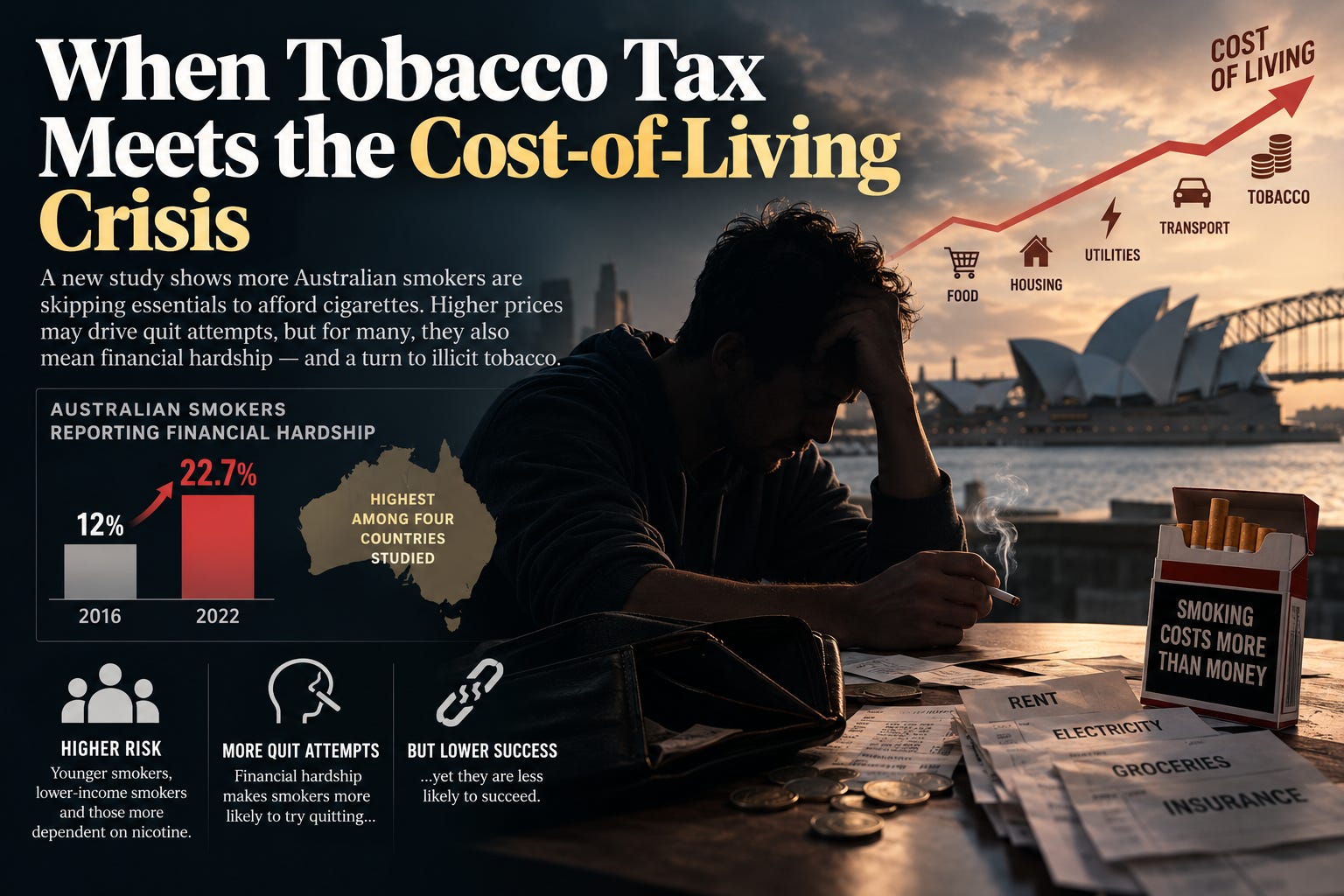
Australia’s tobacco tax policy is built around a simple idea: make cigarettes expensive enough and more people will stop smoking. At a population level, there is good evidence that price matters, because higher cigarette prices can reduce consumption and encourage quit attempts. But a study in Addiction forces us to look at the other side of that mechanism, particularly in Australia: what happens to the people who do not quit?
The study examined smoking-induced deprivation across Australia, Canada, England and the United States using five waves of the International Tobacco Control Four Country Smoking and Vaping Survey between 2016 and 2024. Smoking-induced deprivation was defined as smokers reporting that spending on cigarettes had left them without enough money for basic household essentials during the previous six months. Australia stood out. The proportion of Australian smokers reporting this form of deprivation rose from about 12% in 2016 to 22.7% in 2022, the highest level among the four countries studied. Although it fell somewhat afterwards, it remained above the 2016 level. The people most likely to experience it were younger smokers, people on lower incomes and those with stronger cigarette dependence.
Perhaps the most important finding was that financial hardship appeared to motivate people to try quitting, but did not necessarily help them succeed. Smokers experiencing deprivation were more likely to make a quit attempt, yet among those who tried, they had substantially lower odds of successfully quitting. That distinction matters because financial pressure can create motivation, but it cannot guarantee capability. For a smoker who is able to quit when cigarettes become more expensive, the policy mechanism has worked exactly as intended. For someone who is highly dependent and unable to stop, the same price increase can produce a very different outcome. They may continue smoking and cut back on food, bills, transport or other household necessities instead.
The study also found that smoking-induced deprivation was strongly associated with illicit tobacco use. That does not prove that financial hardship caused people to move into the illicit market, nor does it prove that Australian tobacco excise caused the deprivation. This was an observational study and those causal steps cannot be established from these data alone. But it would be difficult to look at the Australian environment and dismiss the possibility.
Australia has experienced an extraordinary cost-of-living squeeze over roughly the same period. The Reserve Bank has documented sharp pressure on real household incomes since 2022, while the ABS has recorded substantial increases in the cost of food, housing, insurance and other necessities. Tobacco prices have also continued to rise strongly. So can the rise in smoking-induced deprivation be attributed to Australia’s cost-of-living crisis? Not from this study alone. That would go beyond what the evidence can establish. The research was not designed to isolate the effect of inflation, rents, mortgage repayments, food prices or energy costs on smoking-induced deprivation, nor can it separate the contribution of tobacco excise from wider household financial pressure. The peak deprivation estimate in Australia occurred in 2022, which certainly overlaps with the beginning of the recent cost-of-living crisis, but overlap is not causation.
However, the cost-of-living crisis is a highly plausible contributing factor. Think about what the deprivation measure actually captures. It asks whether spending on cigarettes left someone unable to afford household essentials. If food, rent, mortgages, insurance and utilities are simultaneously becoming more expensive while cigarettes also become more expensive, then the amount of financial room available to a dependent smoker shrinks from both directions. The cigarette gets more expensive, everything else gets more expensive, income fails to keep pace, and something has to give. For some people, that something is smoking. For others, it may be food, electricity, rent or another necessity. And for still others, it may be the decision to stop buying legal cigarettes and seek cheaper ones somewhere else.
That is why I think the interaction between tobacco excise and the cost-of-living crisis deserves much more attention than it currently receives. Tobacco taxation is usually discussed as though it operates in isolation. Economists talk about price elasticity, affordability and quit responses, but smokers do not live inside economic models. They live inside household budgets. A very expensive packet of cigarettes means something very different to someone whose rent, mortgage, groceries and insurance have all risen sharply than it did when those other costs were lower.
The same tax can therefore have very different consequences depending on the wider economic environment. This is especially important because the people experiencing the greatest smoking-induced deprivation in the study were those with the least room to absorb it: lower-income smokers, younger smokers and highly dependent smokers. That creates an uncomfortable equity problem. A policy designed to improve health can simultaneously impose the greatest financial burden on the people who are least able to afford it.
That does not automatically mean tobacco excise is wrong. It means we need to judge it by more than its average effect. If a price rise causes some smokers to quit, that is a health benefit. If it causes another group to repeatedly attempt quitting and fail while sacrificing household essentials, that is a different outcome. And if some of those people then move into an illicit market, the price mechanism itself begins to break down.
This is where Australia’s current approach becomes particularly interesting. For decades, tobacco tax policy relied on the assumption that cigarettes would remain expensive enough to discourage smoking while the legal market remained dominant enough for price signals to work. But once a large illicit market develops, the smoker is no longer choosing simply between expensive cigarettes and quitting. There is a third choice: buy cheaper cigarettes outside the legal system. Once that option becomes widespread, repeatedly increasing the legal price may place enormous pressure on compliant consumers without creating the same pressure on those willing or able to access illicit supply.
That changes the economics completely and raises a question tobacco control needs to confront: at what point does a tax designed to reduce smoking begin transferring smokers from the legal market into the illegal one instead? The new Addiction study does not answer that question directly, but it provides an important piece of the puzzle. The smokers suffering the greatest deprivation were more likely to report illicit tobacco use. Again, association is not proof of causation, but it is exactly the pattern we should be investigating.
There is another part of this story that matters to me even more. The study found that people experiencing deprivation were more likely to try quitting but less likely to succeed. That should challenge the idea that smokers facing hardship simply need more financial incentive. They already have one. If you cannot afford household necessities because of cigarettes, there are few stronger financial incentives imaginable. Yet many still cannot stop.
That tells us something fundamental about dependence. You cannot tax dependence out of existence. At some point, policy needs to stop asking how much more pressure can be placed on the smoker and start asking what makes leaving smoking easier. That means affordable cessation support, realistic access to substitutes, recognising that people differ in how they respond to nicotine dependence, and accepting that a lower-risk alternative may sometimes do more good than another price increase.
Australia’s cost-of-living crisis makes that question even more urgent. It would be reckless to claim that the cost-of-living crisis caused Australia’s rise in smoking-induced deprivation, but it would be equally unwise to pretend the two have nothing to do with one another. The sensible conclusion is that they are likely interacting. High cigarette prices create pressure, high living costs reduce households’ ability to absorb that pressure, dependence limits some smokers’ ability to respond by quitting, and illicit supply provides an alternative route for those who cannot or will not pay legal prices.
That is a very different policy environment from the one Australia had twenty years ago, and public health policy needs to recognise when the environment has changed. The purpose of tobacco control should not be to see how much financial pain smokers can tolerate before they stop. It should be to help people stop smoking with the least additional harm possible.
There is a profound difference between making smoking less attractive and making a smoker poorer. For some people, higher prices accomplish the first. This study suggests that for others, we may increasingly be accomplishing the second. And during a cost-of-living crisis, that distinction matters more than ever.
Alan Gor is right to find this recent study in Addition by Ara Cho and colleagues illuminating. It exemplifies how tobacco control has identified a package of strategies to reduce smoking and then ignored what it just does not want to see. This includes the serious adverse effects of some of these strategies, the failure of most countries to implement these strategies at all or to scale and then ignores the extraordinary new opportunities that have arisen with the growing range of safer nicotine products. Cigarette excise is inherently economically regressive but tobacco control supporters have argued that the health benefits from quitting smoking because higher cigarette excise made smoking unaffordable increased income through greater engagement with employment. Whether this is true in a particular country at a particular time will depend on many other factors. The Laffer curve posits optimal levels of taxation with higher taxation rates generating less income because of lower compliance while lower taxation rates have high compliance but generate less revenue because of the lower taxation rate. It has been depressing in Australia to observe the complete lack of interest in the detrimental effects of sky high cigarette excise and vape quasi prohibition on low income and other disadvantaged populations.
Thank you for discussing the findings from this study Al. Australia's cost of living crisis and the rapid expansion of the Black Market has created an environment that threatens the very foundations of our civil society - social cohesion.
People who would normally not engage in unlawful activities are now very familiar with other markets that they previously had no idea about, which has expanded due to this latest level & type of demand.
Tobacco, vapes, alcohol, meat, seafood, fuel, prescription medications, sex, labour hire, white goods, tech/electronics, Illicit drugs, firearms . . . you name it, someone will supply it.
The more the government tightens their perceived control the larger the demand becomes. I can't see this current situation changing anytime soon.
Meanwhile, in the streets, flanalette shirts are rubbing shoulders with uniforms & suits as they line up for the 'man in the van' - and who can blame them?