

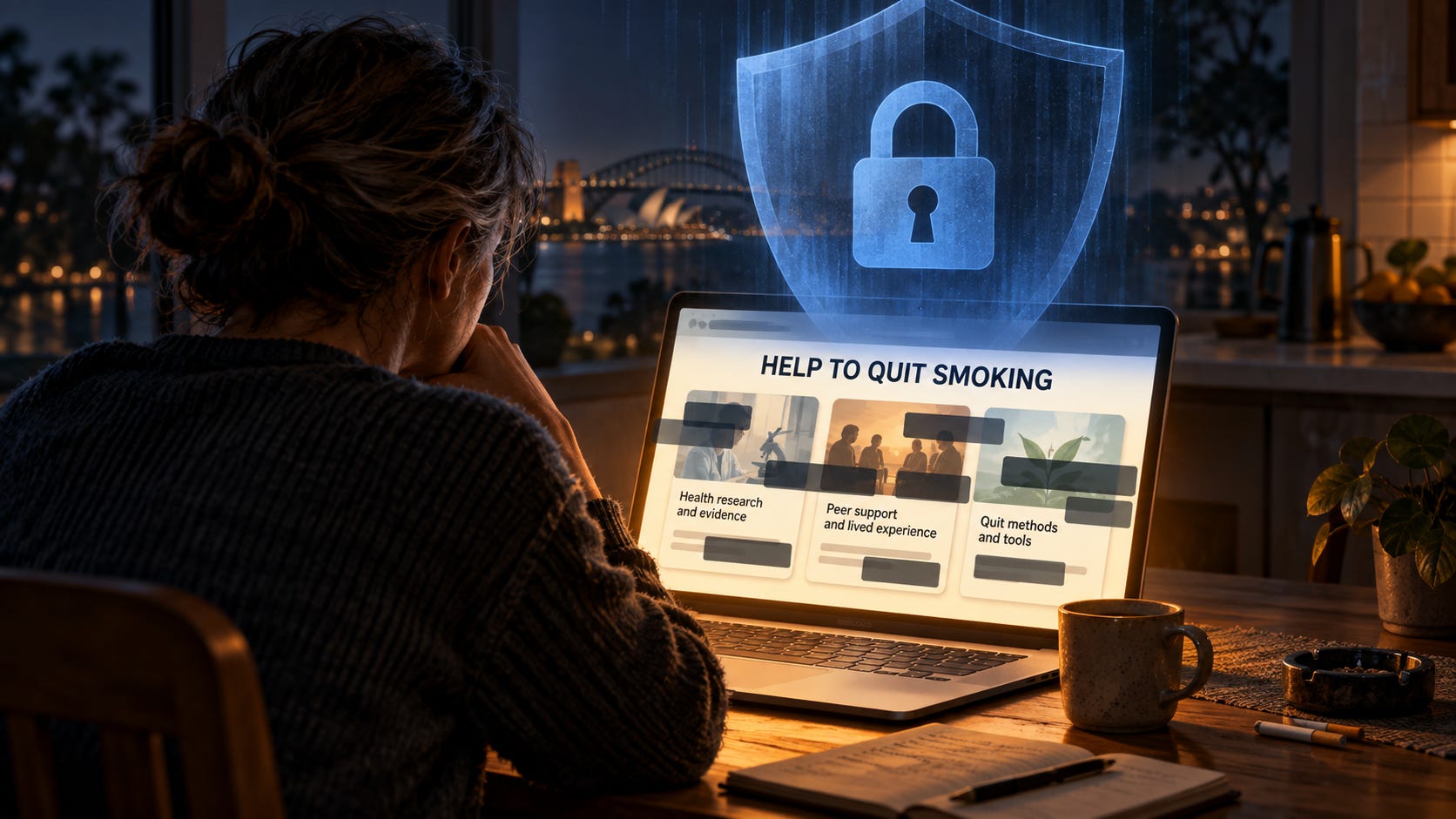
Imagine an adult who has smoked for decades, tried to stop several times and is looking online for another way forward. They want to understand the evidence, hear from people who have stopped smoking, and figure out what questions to ask a health professional.
Now imagine that the information most useful to them becomes harder to find because a platform decides that discussing nicotine is more trouble than it is worth.
That is a possible consequence worth examining. It is not an outcome established by the proposed legislation. But a recent warning from the Self Help Addiction Resource Centre, SHARC, gives us a reason to ask whether efforts to make the internet safer could inadvertently weaken tobacco harm reduction.
On 25 September, SHARC warned that the proposed digital duty of care could restrict legitimate health information and peer support. It is concerned that platforms trying to avoid liability may suppress material intended to help people, alongside material that genuinely puts them at risk. SHARC supports stronger online safety. It is asking for safeguards against unintended harm.
Supporting online safety does not require us to assume that every restriction introduced in its name will improve health.
The government released the exposure draft of the Online Safety Amendment (Digital Duty of Care) Bill 2026 on 8 September. The consultation page set a feedback deadline of 22 September. This article examines that draft, rather than assuming its wording will become the final law.
The proposal places a duty on online service providers to maintain a safe environment so far as reasonably practicable. Proposed section 25C(1)(k) includes material that “encourages, promotes, urges or instructs illicit drug use” within seriously harmful material and conduct.
SHARC’s submission argues that practical harm reduction information could be misclassified under this wording. It seeks explicit protection for health information, lived experience, peer communication and policy advocacy, together with accessible appeals when lawful material is restricted.
The connection to tobacco harm reduction needs care. The draft does not expressly identify vaping or tobacco harm reduction as prohibited subjects. Nor should we assume that nicotine use falls within the provision concerning illicit drugs. The legal status of a product, its supply and its use are separate questions.
The credible THR concern is broader moderation and the chilling effect of uncertainty. There is no evidence that this draft automatically bans discussion of vaping.
Consider three hypothetical posts. A researcher explains the findings of a smoking cessation trial. A former smoker describes how they stopped smoking. A consumer organisation argues for a different system of nicotine regulation.
Each requires a different assessment from a seller advertising unlawful products. Yet a moderation system that treats positive discussion of vaping as promotion could struggle to preserve those distinctions. Whether that happens would depend on the final rules, regulatory guidance and the decisions platforms make.
There is a health reason to get those distinctions right. Cochrane’s review, published on 26 August 2026, concludes that nicotine e-cigarettes improve smoking cessation rates compared with nicotine replacement therapy, with high certainty. It also stresses the need for longer and larger studies to assess safety fully, and cautions that illicit products may have different harm profiles from the regulated products studied.
An adult should be able to encounter both parts of that finding. They should be able to learn that an intervention can help people stop smoking and that important uncertainties remain. Making the first part difficult to discuss does not make the second part more accurate.
The purpose of health communication is to help people understand their choices. A system that permits warnings but discourages discussion of potential benefits could leave people with a distorted picture, even if every warning it allows is individually defensible.
Australia already restricts vaping advertising. TGA guidance says advertising vaping goods is prohibited unless authorised, with limited permitted circumstances. Those rules are an existing regulatory framework, separate from the proposed digital duty of care.
That makes clarity more valuable. Platforms need workable ways to distinguish advertising from independent reporting, research discussion and public debate. The distinction must consider context and purpose; attaching the words “harm reduction” to an advertisement cannot automatically make it legitimate.
Equally, a favourable scientific finding cannot become advertising simply because somebody would prefer the finding to be unfavourable.
For consumer advocates, the issue is also personal. When I describe my experience of leaving cigarettes behind, I am contributing something that a clinical trial cannot supply on its own: an account of what smoking, failed attempts to stop and eventual change felt like.
My experience does not establish what will work for everyone. It does not remove the need for research. But it belongs in the conversation.
Imagine asking people to contribute their lived experience to public health, then building a digital environment in which their stories become suspect whenever they describe a benefit from a contested intervention. Participation would become conditional on reaching the approved conclusion.
That would impoverish policy debate. We need to hear from people helped by an approach, people harmed by it and people it failed to reach. Their accounts can expose questions that official evaluations have missed. They also need room to disagree.
There is another potential consequence: reform advocacy could become confused with encouragement to break existing rules.
Arguing that Australia should establish a licensed adult market for lower-risk nicotine products is a proposal to change policy. It is different from directing someone to an unlawful supplier. A sound moderation system should be able to recognise that difference.
Otherwise, the existence of a restriction could become a reason to restrict discussion of whether the restriction works. That would correct harder precisely when correction might be needed.
The danger need not take the form of a spectacular ban. It could be a post removed, a discussion group closed or useful information becoming less visible. These are possible pathways, not documented effects of this draft on THR. Their significance is that information can remain technically available while becoming practically difficult to reach.
For someone considering another attempt to stop smoking, practical access is what counts. An evidence review cannot help them make an informed decision if they never encounter it.
The answer is to build protections into the policy before these disputes arise. Legitimate health education, independent research, personal accounts and democratic advocacy need clear treatment. Platforms should explain restrictions and offer meaningful review. People with experience of smoking and switching should help shape guidance alongside researchers, clinicians and other affected communities.
Those protections should coexist with action against unlawful selling, misleading claims and marketing directed at children. Precision strengthens enforcement by making its target clearer.
We should also evaluate what the policy does to useful information. Counting removals would tell us little about whether an online environment has become healthier. An evaluation should ask whether adults can still find cessation evidence, whether health organisations can reach their audiences and whether lawful discussion is restored when moderation gets it wrong.
A duty of care should include care about the consequences of withholding information.
SHARC has raised a warning that reaches beyond its immediate field. Tobacco harm reduction advocates should take it seriously while remaining accurate about what the draft says and what we are predicting.
The question is whether Australia can address harmful online content without making useful health communication collateral damage.
For the adult still smoking, that distinction could matter far more than the reassuring name of the legislation.
Before the government asks platforms to remove harmful information, it must make sure they can recognise information that helps people escape harm.
Awesome stack
But sadly I don't think we/you are going to get anywhere thr wise until 2 things happen
Yep, me banging same old drums
ATO very deep audit starting at albarse
Banning any blamblam influence in aussie
Hope im wrong but check Philippines???