

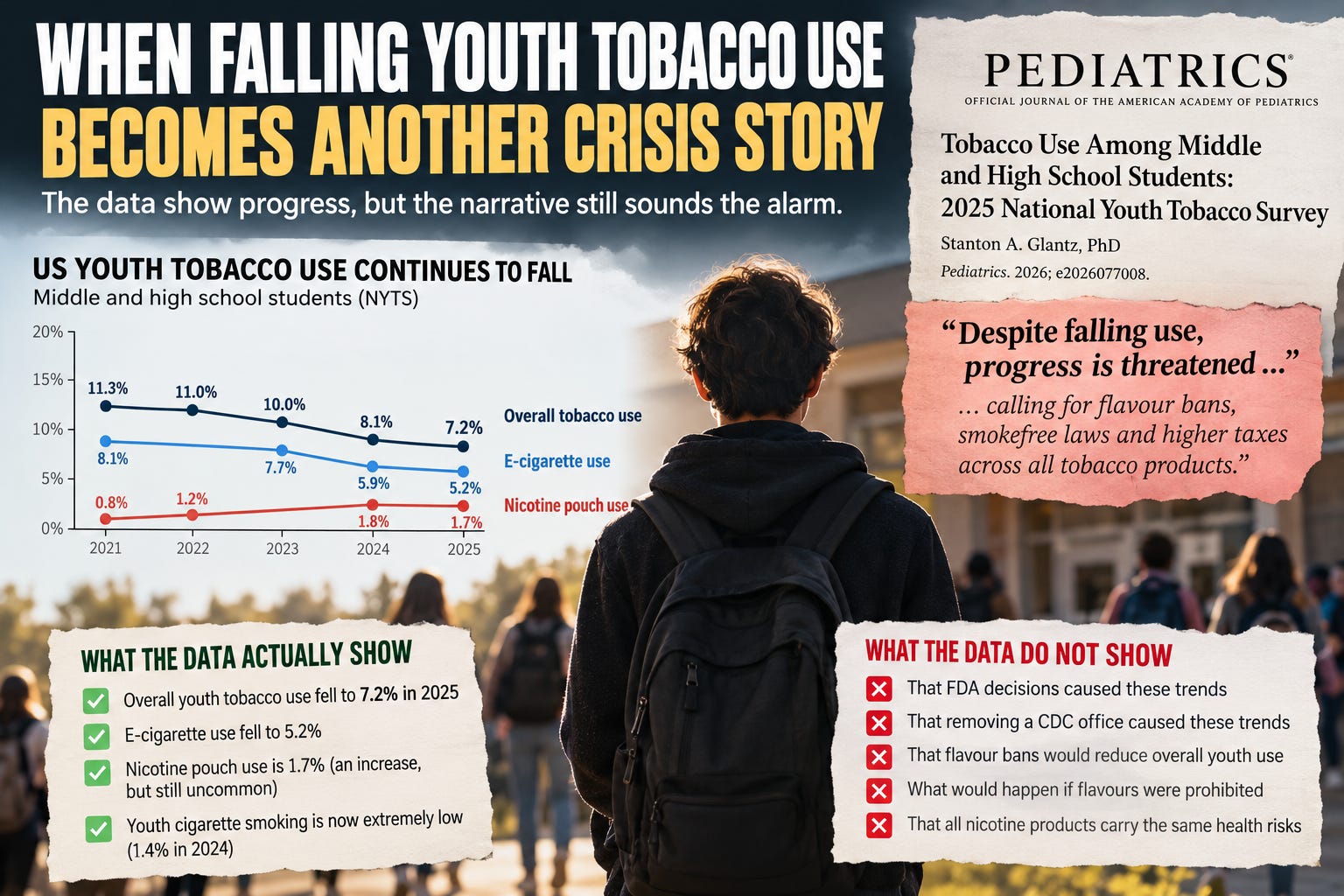
There is something revealing about the way tobacco-control data are sometimes presented. When the numbers move in the wrong direction, they are treated as evidence of failure, but when the numbers move in the right direction, they can still somehow be presented as a warning that failure is just around the corner. Stanton Glantz’s new paper in Paediatrics, using the 2025 National Youth Tobacco Survey, is a good example. The headline finding should be encouraging: tobacco use among US middle and high school students continued to fall in 2025, reaching 7.2%. E-cigarette use was 5.2%, while nicotine pouch use was 1.7%. That continues a substantial downward trend. In 2023, 10.0% of US middle and high school students reported current tobacco-product use and 7.7% reported current e-cigarette use. In 2024, those figures had fallen to 8.1% and 5.9%, and by 2025, according to Glantz’s analysis, both had fallen again. That is progress.
It does not mean youth nicotine use should be ignored, it does not mean there are no remaining problems, and it certainly does not mean nicotine pouches, vaping or cigarettes should be freely marketed to children. But it does mean we should be capable of recognising what the data actually show before moving immediately to the next alarm. Instead, much of the emphasis in the paper falls on nicotine pouches because their prevalence “doubled” from 0.8% in 2021 to 1.7% in 2025. Technically, that is true, but “doubled” sounds rather more dramatic than “increased by 0.9 percentage points over four years”. And there is another detail that matters. In the official 2024 NYTS, nicotine pouch use was already 1.8%, so the 2025 estimate of 1.7% is not evidence of continued year-on-year acceleration. It is slightly below the previous year’s estimate. That does not make nicotine pouch use irrelevant. It makes context important.
The same problem appears in the discussion of vaping “intensity”. The paper notes that among young people who currently vape, the proportion vaping daily has risen substantially over time, from 9.4% in 2014 to 35.4% in 2025. Again, that sounds worrying in isolation, but this statistic describes the composition of the remaining vaping population. It does not mean that 35.4% of all students vape daily. Those are very different things. As total youth vaping prevalence falls, it is entirely possible for the remaining group of users to become increasingly concentrated among more regular users. Imagine 100 young people. At one point, 20 of them vape and two vape daily, so daily users represent 10% of vapers. Later, only five vape, but two still vape daily, so youth vaping prevalence has fallen dramatically while daily users now represent 40% of the remaining vapers. Both statistics are true, but presenting only the second one can make an improving population trend look like deterioration.
And this matters because the overall US trend is difficult to dismiss. CDC reported that youth e-cigarette use fell from 7.7% in 2023 to 5.9% in 2024. Among high-school students specifically, it fell from 10.0% to 7.8%. Overall tobacco-product use fell from 10.0% to 8.1%, representing roughly 550,000 fewer current users in a single year. Glantz’s 2025 analysis now reports another fall in e-cigarette use, to 5.2%, and another fall in overall tobacco use, to 7.2%. Those numbers deserve to be taken seriously.
What I find much harder to accept is the leap from those descriptive data to the policy claims in the paper’s conclusion. The NYTS is a survey. It tells us how many students report using particular products and how those patterns change over time. It does not establish what caused those changes. Yet the conclusion warns that the elimination of the CDC Office on Smoking and Health and “pro-tobacco” FDA regulatory decisions threaten progress, and then argues for flavour bans, smoke-free laws and consistently higher taxes across tobacco products. Those may be policy positions the author strongly believes in, but the 2025 NYTS does not test them. It does not contain a randomised experiment examining FDA policy, it does not compare otherwise identical jurisdictions with and without a CDC office, it does not establish that comprehensive flavour bans caused the decline, and it certainly cannot tell us what youth tobacco prevalence would have been under a different national regulatory regime. Those conclusions are advocacy layered on top of descriptive epidemiology.
That distinction matters. There is nothing wrong with researchers discussing policy implications, but readers should be able to see where the data end and the policy argument begins. The same caution applies to flavours. The paper reports that most youth using tobacco products use flavoured products. That is relevant, but prevalence among existing users does not, by itself, tell us what would happen to overall tobacco use if flavours were prohibited. Would some young people stop entirely? Probably. Would some switch products? Possibly. Would illicit supply emerge? Also possible. Would adult smokers who currently use flavoured alternatives be affected? Almost certainly. Those are empirical questions. They cannot be answered simply by observing that flavours are popular among users.
This is where harm reduction requires us to look at more than one population and more than one outcome at the same time. A flavour that attracts a nicotine-naive teenager can be undesirable, while the same flavour may help a 40-year-old smoker find vaping sufficiently acceptable to replace cigarettes. Both propositions can be true. The task of good regulation is not to pretend one population exists and the other does not. It is to maximise benefit while reducing harm.
There is another issue hiding inside the NYTS figures that deserves far more attention. Cigarette smoking among US youth is now extraordinarily low. In the 2024 NYTS, only 1.4% of middle and high school students reported current cigarette smoking. That is an extraordinary public-health achievement when viewed against previous generations. Yet much of the debate remains centred on whether vaping prevalence can be pushed ever closer to zero, rather than asking the broader question: what pattern of nicotine use produces the least disease over a lifetime?
That distinction matters because not all nicotine products carry remotely similar health risks. A cigarette is a combustion product. A nicotine pouch is not. A vape is not. That does not make the latter two harmless. It means that counting all of them under the same umbrella of “tobacco product use” can obscure clinically important differences. If one generation reaches adulthood with dramatically less cigarette smoking but some residual use of substantially lower-risk nicotine products, that is not necessarily the same public-health outcome as a generation with identical overall “tobacco-product” prevalence dominated by cigarettes. The category matters, the product matters, the route of delivery matters, and ultimately the disease burden matters.
Public health should be confident enough to say that youth tobacco use is falling, youth vaping is falling, youth cigarette smoking is extremely low, nicotine pouch use remains uncommon but deserves monitoring, and among the shrinking group of young people who vape, a larger proportion are regular users and may need more targeted cessation support. That is a much more accurate picture than another declaration that disaster is imminent.
The irony is that if we insist every dataset must validate the same predetermined narrative, eventually the public notices. When prevalence rises, regulation is urgently needed. When prevalence falls, regulation is credited. When prevalence falls despite regulatory decisions researchers dislike, those decisions are suddenly said to “threaten progress”. At some point, the policy position becomes unfalsifiable. That is not how evidence-based policy should work.
The 2025 NYTS tells us something genuinely important. Youth nicotine use has not disappeared, but youth tobacco use, youth vaping and cigarette smoking are moving strongly downward. The right response is not complacency, nor is it panic. It is to ask why the progress is occurring, identify the remaining problems, target interventions at the people who actually need them, and remain open to the possibility that a nicotine market increasingly dominated by non-combustible products may require a different regulatory framework from the cigarette-dominated world that tobacco control was originally built to confront.
Because eventually we have to decide what success looks like. If success means fewer young people smoking cigarettes, these numbers deserve considerable celebration. If success means nobody ever using nicotine in any form, then almost every new product will look like failure regardless of what happens to smoking. Those are not the same public-health goal, and we should at least be honest about which one we are pursuing.
Glantz is the main voice of a fundamentalist orthodoxy that is slowly loosing the unquestioned total intellectual and political authority they wielded for decades to influence regulation, the political class and control the narrative (not to mention the threat to NIH and Bloomberg funding). This authority could be justified in utilitarian terms, given the real harms from cigarette smoking and the misdeeds of Big Tobacco. Glantz is their poster boy because he is skillful in presenting in "sciencey" format the top emotional argument, regardless of speculating on a grossly biased and unreasonable interpretation of NYTS data. Glantz utterances reflect the fact that changes in the vaping era challenge and threaten their authority and control. Any concession to THR represents for the orthodoxy an existential threat that did not occur before the vaping era. The orthodoxy is a acting like a besieged power defending "youth vaping" as a last stand, they will not recognize that it has decreased below their NYTS levels of 2014. Without the emotional mobilizing theme of "youth vaping" they are naked. However, having said this, we need to keep pounding and criticizing their "soft power" to generate sufficient momentum to convince that "hard power" (real decision makers) that the current status quo is disastrous and unsustainable.
Brilliant article Alan, you covered so much.