
The Questions That Change Everything

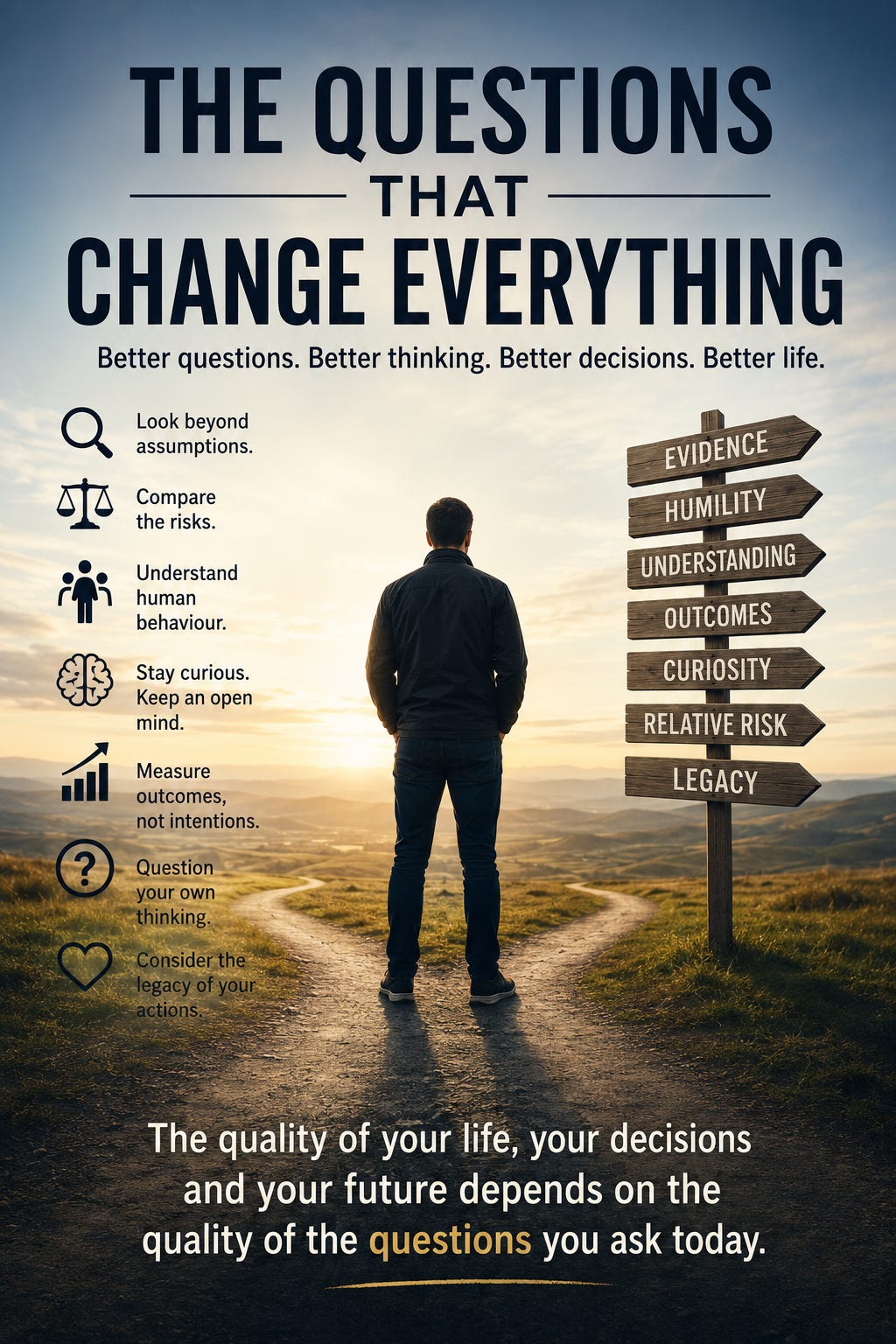
Every day we ask questions. Some are small. What should I have for dinner? Should I take this route home? Should I buy this or wait until next week? Others quietly shape the course of our lives. Should I change careers? How should I raise my children? What kind of person do I want to become? What will people remember me for? The quality of our lives is determined less by the answers we find than by the questions we choose to ask.
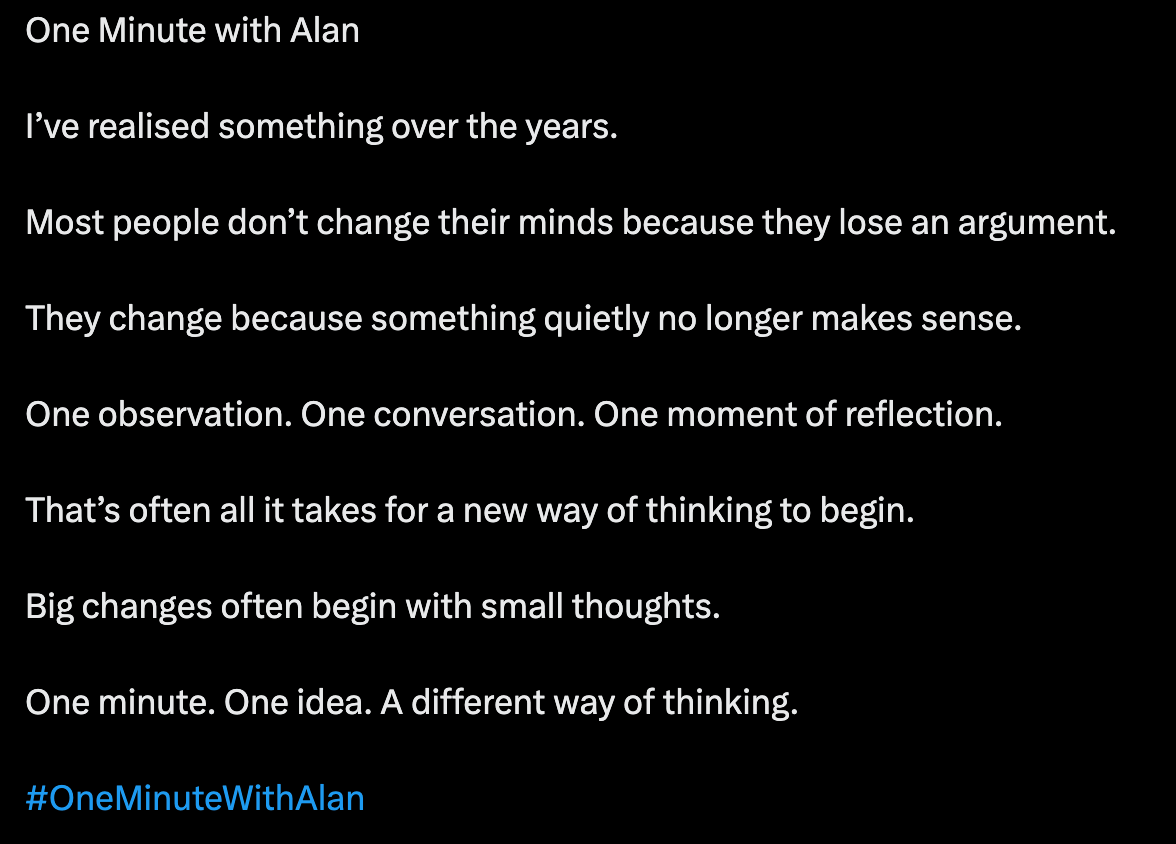
That is the philosophy behind One Minute with Alan. It is not about telling people what to think because there is already more than enough of that in the world. Every day we are surrounded by opinions, certainty, outrage and confident declarations that leave little room for curiosity. The real purpose is something much simpler and, perhaps, much more valuable: encouraging people to think more deeply, because better questions change everything.
Throughout history, progress has rarely begun with certainty. It has almost always begun with someone asking a question everyone else assumed had already been answered. What if the Earth wasn’t the centre of the universe? What if washing our hands prevents disease? What if ulcers aren’t caused by stress? What if we have misunderstood something fundamental? The greatest advances in science, medicine, business and society usually begin with someone willing to challenge what everyone else accepts without question, and that requires humility.
Humility is one of the most underrated qualities in modern life. It does not mean lacking confidence. It means recognising that our current understanding may be incomplete, accepting that evidence can surprise us and being willing to change our minds when reality changes. Unfortunately, certainty is often rewarded more than curiosity. Confident people receive the interviews. Certain experts receive the headlines. Simple slogans spread further than nuanced explanations, yet reality is rarely simple. Life exists in shades of grey while public debate often demands black and white.
One of the most important questions we can ask is, “What if this is more complicated than it first appears?” That single question can prevent countless mistakes because it encourages us to look beyond first impressions, reminds us to separate emotion from evidence and slows us down just enough to avoid rushing towards conclusions that feel satisfying but may ultimately prove wrong.
Nowhere is this more important than in public policy. Every policy begins with good intentions. The intention may be to reduce crime, improve health, protect children or help vulnerable people, but intentions are only the beginning. The far more important question is, “What actually happened?” Too often, success is measured by what governments hoped would happen rather than by what actually occurred. Did smoking fall? Did fewer people die? Did organised crime expand? Did consumers behave as predicted? Did the policy produce unexpected consequences? Reality has no obligation to respect our intentions. Markets respond, people adapt, technology evolves, and human behaviour often surprises us. Good policy accepts this. Poor policy resists it.
One of the greatest mistakes we make is assuming that people behave like spreadsheets. On paper, many policies appear perfectly logical. Raise the price and demand falls. Ban the product and use disappears. Restrict supply, and the problem is solved. Real people rarely behave that neatly because people value convenience, seek pleasure, avoid pain, compare alternatives and constantly make trade-offs. They respond to incentives in ways that economists, psychologists and behavioural scientists have been studying for decades. Ignoring human behaviour does not eliminate it. It simply guarantees that policy will eventually collide with reality.
This principle extends far beyond governments. Businesses fail when they design products nobody actually wants. Managers struggle when they treat employees as interchangeable rather than understanding what motivates them. Parents quickly discover that children do not respond to instruction manuals. Relationships flourish when we seek to understand before trying to be understood. Every meaningful decision begins with understanding people as they are rather than wishing they were different.
Another question worth asking is, “Compared with what?” This may be one of the most neglected questions in modern thinking because too many decisions are made in absolutes. Is something safe? Is it dangerous? Is it good? Is it bad? Reality is almost always relative. Driving carries risk. Cycling carries risk. Crossing the road carries risk. Medicine carries risk. Doing nothing often carries risk. The real question is rarely whether risk exists. The question is whether one option is safer than another, and that distinction matters enormously because it is how doctors recommend treatments, engineers build safer aircraft, investors assess opportunities, and families make everyday decisions.
It is also central to discussions around tobacco harm reduction, where the question is not whether nicotine products are completely harmless but whether they expose people to substantially fewer harms than combustible cigarettes. That is a relative risk question. Whether discussing medicine, transport, finance or public health, relative thinking almost always leads to better decisions than absolute thinking.
The same principle applies to leadership. Strong leaders are not those who always have the answers. They are the ones who ask the questions nobody else is asking. What are we missing? Who disagrees with us? What evidence would change our minds? Have we measured outcomes or simply assumed success? What unintended consequences might emerge? These questions create stronger organisations because they prevent complacency.
The same is true within families. Some of the most important conversations begin with simple questions. How are you really feeling? What matters most to you? How can I help? What kind of example am I setting? What memories am I creating? Success at home rarely depends on having perfect answers. It depends on asking questions that demonstrate genuine curiosity and care.
There is another question I have found increasingly valuable as I have grown older. “What if I am wrong?” Years ago I would probably have found that uncomfortable. Today I find it liberating because being wrong is not failure. Remaining wrong after the evidence changes is. Science advances because researchers expect to be challenged. Businesses improve because customers identify flaws. Personal growth happens because experience teaches us what books never could. Changing our minds should never be seen as weakness. It is often evidence that we are learning.
Perhaps the most important question of all concerns the legacy we leave behind. When the debates end, the headlines fade and today’s controversies become tomorrow’s history, what will matter most? Not whether we won every argument or always appeared right, but whether we treated people fairly, remained intellectually honest, followed the evidence even when it challenged our own beliefs, dared to admit uncertainty and used our actions to make life better for someone else. That is the legacy worth pursuing.
One Minute with Alan is not intended to provide all the answers because no single minute ever could. Its purpose is much more ambitious. It exists to encourage a habit of thinking, to pause before reacting, to look beneath the surface, to examine evidence instead of headlines, to understand people instead of judging them and to ask better questions before reaching stronger conclusions. The quality of a society depends on the quality of its thinking, and the quality of our thinking depends on the quality of our questions.
Perhaps that is the most important lesson of all. The questions that change everything are rarely the loudest. They are usually the quiet ones we ask ourselves. What do I know? What don’t I know? What evidence am I missing? What assumptions have I accepted without testing? What kind of person do I want to become?
If each of us asked those questions a little more often, our public debates would become more thoughtful, our policies more effective, our relationships stronger and our lives richer. That is my hope for this monthly series. Not that you agree with everything I write, but that every month you leave asking one better question than when you arrived, because that single question may be the one that changes everything.