

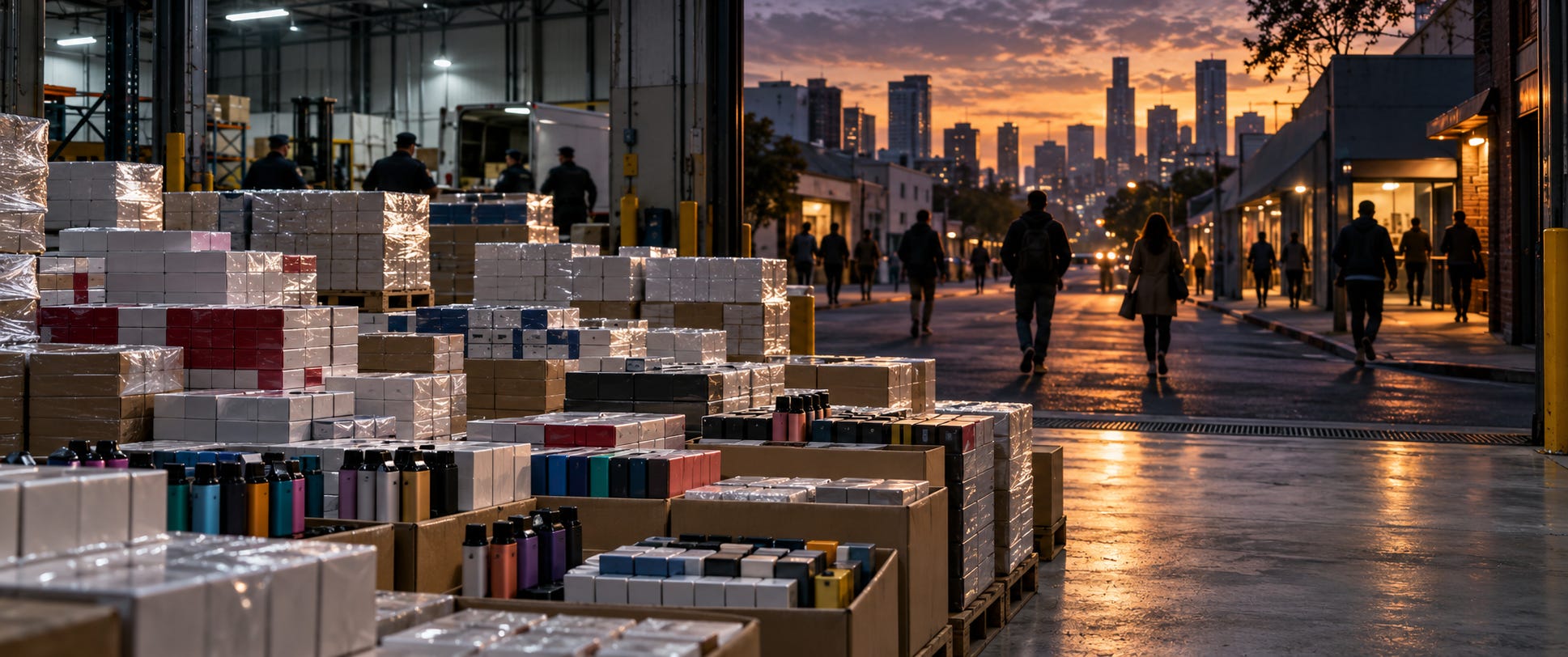
Another truck is stopped. Another warehouse is raided. Another photograph shows rows of boxes stacked across the floor. The announcement gives us a number: millions of cigarettes, thousands of vapes, tonnes of tobacco. It tells us their estimated value, the duty supposedly avoided and sometimes how many arrests were made.
Then the story ends.
But the public health question begins at precisely that point. What happened to demand after the products disappeared? Did the people who wanted them stop smoking or vaping? Did they buy legal cigarettes instead? Did they find another illicit seller? Did someone who had switched from cigarettes to vaping go back to smoking? Without answers, a seizure tells us what authorities removed from one supply chain. It does not tell us what happened to health.
Australia has no shortage of impressive enforcement numbers. The Australian Border Force reported 23,097 illicit tobacco detections in 2024–25, involving 2.53 billion cigarette sticks and 435.46 tonnes of loose-leaf tobacco. It also reported seizing more than six million illicit vaping products at the border. These are real operations involving real work, and disrupting criminal supply can matter. But the quantities are outputs of enforcement. They are not measurements of how many people quit smoking, how many cigarettes were consumed or how many adults lost access to an alternative they preferred.
Even the ABF’s own enforcement commander acknowledged the limit: “we can’t seize this problem away.” The agency said border action must be combined with education, health measures and domestic enforcement.
There is a simple reason a larger seizure total does not automatically mean a smaller market. It could mean more effective detection. It could mean more attempted imports. It could mean both. If ten containers arrive and one is found, that is a different result from ten arriving and nine being found, even if the photograph of the one container looks exactly the same. We need to know something about the traffic that escaped detection before we can tell how much supply was actually reduced.
And supply is only half the story. A person who expects to buy a cheap pack of cigarettes on Friday does not necessarily abandon nicotine when one shipment is confiscated on Tuesday. They may pay more, travel further, try another shop, buy legal cigarettes, reduce consumption or make a quit attempt. Those possibilities have very different implications for health and crime. The seizure photograph cannot distinguish between them.
The distinction becomes more urgent when cigarettes and vapes appear in the same enforcement announcement. An illicit cigarette is still a combustible cigarette. Removing it could be beneficial if the buyer stops smoking, but that benefit cannot simply be assumed if another seller replaces it. A seized vape raises a different question: if an adult smoker was using it instead of cigarettes, what product did they use next? That person might quit nicotine, obtain a legal vape, find another illicit vape or return to cigarettes. The direction of the health effect depends on the answer.
Organised crime, intimidation and violence deserve a serious response. So does the public health result of that response. A successful raid can remove dangerous operators and still have little measurable effect on smoking. It can also create a genuine opportunity for quitting if support and acceptable alternatives are available. We should find out which occurred.
The Australian Bureau of Statistics offers a warning against mistaking the visible legal market for the whole market. Its experimental estimates, published in June 2026, suggest that nicotine consumption rose by almost 40 per cent from 2017 to 2025 while legal tobacco consumption fell sharply. The ABS estimates a large shift toward illicit products. Its method uses wastewater to estimate overall nicotine consumption, then other data and modelling to allocate that consumption among products. Wastewater alone cannot identify whether nicotine came from a cigarette, a vape, a pouch or nicotine replacement therapy, and the allocation rests on assumptions. These figures deserve scrutiny. But they illustrate the central problem: falling legal sales cannot, by themselves, tell us that people are using less nicotine or smoking fewer cigarettes.
Nor should we reverse that mistake and claim the ABS figures prove that any particular seizure failed. A national estimate covering years cannot tell us whether a raid in one suburb changed purchasing the following week. The data answer different questions. That is exactly why we need evaluation designed around what happens after enforcement.
For a major intervention, authorities could report more than the confiscated quantity. Did local availability and prices change, and for how long? Did nearby sellers close or rapidly replace stock? Did purchases move to other suburbs, delivery services or online channels? Did legal cigarette sales rise? Did smokers report more quit attempts and sustained abstinence? Did vapers who previously smoked remain smoke-free? Were changes different in a comparable area without the intervention? Repeated surveys and market monitoring could help separate a lasting effect from a short disruption. No single measure would settle the question, but together they could tell a far more honest story.
Timing matters too. A raid may interrupt supply for days while a criminal network adapts over weeks. A person may attempt to quit, relapse and later try again. A one-week snapshot can miss both outcomes. If a policy claims to reduce smoking, it should track smoking and quitting over time. If it claims to dismantle illicit distribution, it should track replacement sellers and persistent availability. And if it claims to protect young people, it should measure youth use separately from adult smoking and adult use of lower-risk alternatives.
I understand why seizure numbers dominate the news. They are immediate, countable and easy to photograph. The alternatives take longer to measure and may produce uncomfortable answers. Yet a government cannot declare a public health victory simply because it has counted the boxes it captured. People continue making decisions after the cameras leave.
Imagine two possible outcomes from the same headline: one million cigarettes seized. In the first, the local supply dries up, prices rise, smokers receive useful support and some stop smoking for good. In the second, another supplier fills the gap by the weekend and nothing changes except who earns the money. The press release would look much the same. The health outcome would not.
We should recognise the work involved in seizing illicit products and insist on knowing whether that work achieves its purpose. Count the seizures. Then count the smokers, the quit attempts, the switches between products and the replacement sellers. Follow the demand.
The most important number may be the one that never appears beneath the photograph: how many people were smoking a month later?
Alan, thank you for this important post. Seizures make headlines, and the public at large feel vindicated in some way, forgetting to ask what is the impact on smokers and vapers as a result. Given the enormous profits available to illicit sellers, a few seizures are unlikely to make much difference. You are right to remind us that public health effects, not seizure numbers, are what should be measured.
Definitely an interesting perspective- Alan, next week I will talk about nicotine.