

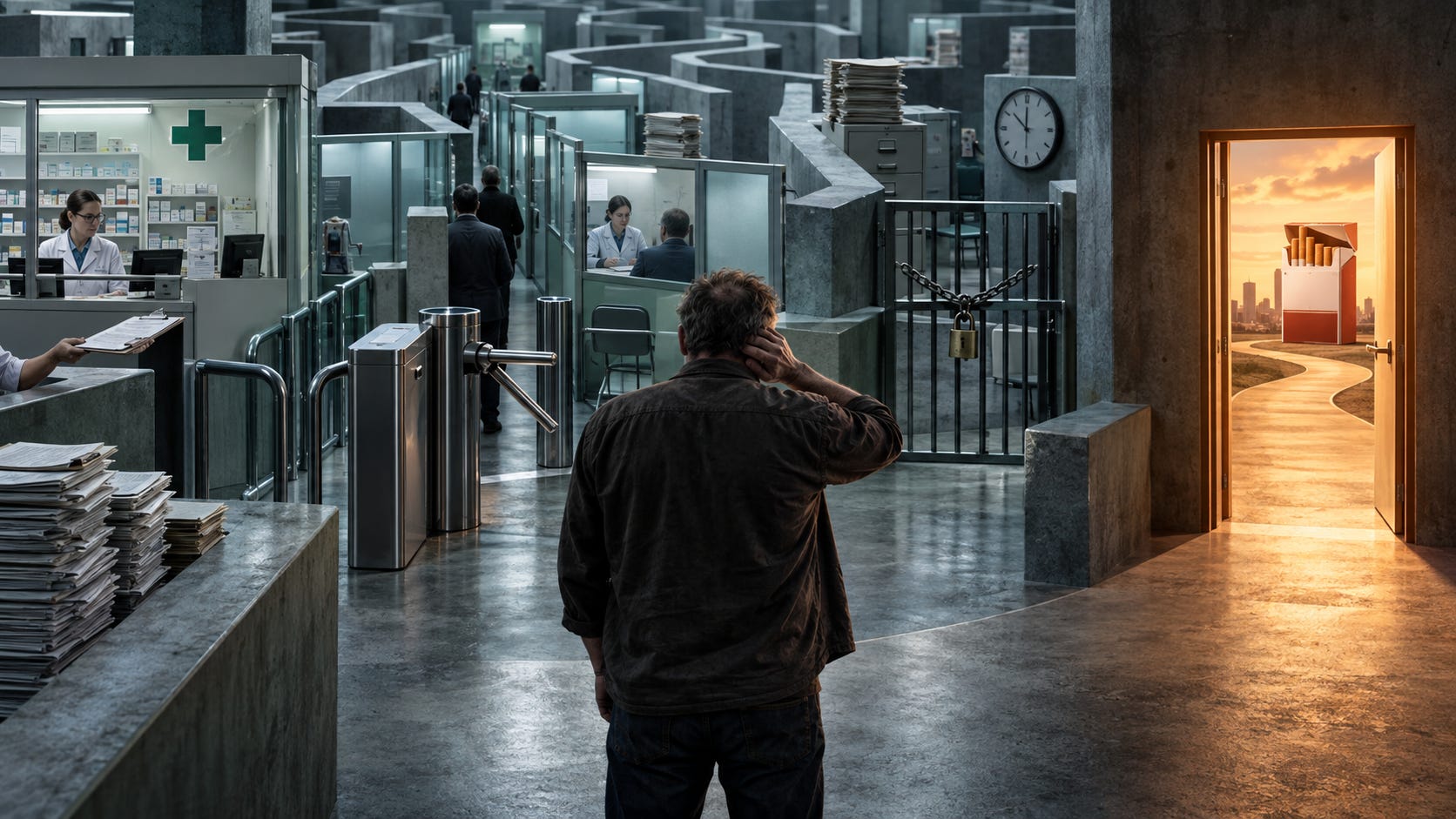
You wake at 6.15 am and automatically reach for the packet beside the bed. There are four cigarettes left. You are not a teenager, you are not curious about nicotine, and you are not being seduced by fluorescent packaging on social media. You are 47 years old, you have smoked for 26 years, and you are tired of planning your day around a product you no longer enjoy. You have tried to stop before, more than once, but today you decide to try again.
Welcome to the Public-Health Escape Room. Your objective is simple: stop smoking and get out alive. The people who designed the room say they want you to succeed. Every wall carries a slogan about quitting, and every official standing outside insists the exit has never been easier to find.
You have four meters: money, time, satisfaction and certainty. If any one of them reaches zero, the cigarette door opens automatically. It is the only door in the room that is never locked.
On the first wall is a large red button marked “JUST STOP”, so you press it. For several hours, you do not smoke, but by lunchtime you are irritable and unable to concentrate. The ritual is missing, as is the rapid nicotine delivery your brain has expected for decades. You drink coffee, walk around the block and remind yourself why you are doing this.
At 3.20 pm, something goes wrong at work, and your craving meter begins flashing. You can keep going without assistance, which costs nothing and is immediately available, but offers little satisfaction and considerable uncertainty. Alternatively, you can buy cigarettes. The cost is very high, but access is easy, the experience is familiar, and there is almost no uncertainty about what will happen next.
You choose to keep going because this is a public-health game and you are trying to make the healthy decision. At 5.40 pm, however, you pass a shop selling cigarettes. Nobody asks you to make an appointment, assesses whether cigarettes are clinically appropriate or explains that smoking is an unapproved treatment for stress. Nobody asks what else you have tried. You show your age, pay and leave. The packet carries horrifying images, but it opens perfectly.
Your first escape attempt has failed, and the game congratulates you for trying.
You restart the following morning and choose the officially preferred route. The next corridor contains nicotine patches, gum, lozenges and sprays. These products are regulated, familiar and widely available. They have helped many people quit, and they may help you too.
You buy patches and gum, read the instructions, wear the patch and use the gum whenever cravings break through. The nicotine withdrawal becomes more manageable, but something is still missing: the hand-to-mouth action, the inhalation, the pause, the sensory cues and the speed with which relief arrives. Smoking was never merely a chemical transaction. It was a behaviour repeated thousands of times until it became stitched into the fabric of your day.
After a week, you are still spending money, fighting cravings and thinking constantly about cigarettes. You can continue with a treatment that is not satisfying enough and watch your money, satisfaction and hope slowly fall. You can try a prescription medicine, which may require a medical appointment, eligibility questions, possible side effects and another wait. Alternatively, you can return to smoking, because the familiar door remains open.
This is not an argument against patches, gum or medicines. They are valuable options, and some people do very well with them. It is an argument against pretending that everyone experiences nicotine dependence in the same way or will escape through the same door.
You choose the prescription option. The medicine helps, but you stop taking it after experiencing unpleasant side effects. Your second escape attempt has failed. The game records another “unsuccessful quit attempt”, but it does not record how hard you worked.
The next room contains a screen displaying the scientific evidence. The latest Cochrane review says nicotine e-cigarettes help more people stop smoking for at least six months than nicotine-replacement therapy. Across the evidence reviewed, about 8 to 10 people in every 100 quit using nicotine e-cigarettes, compared with about 6 in every 100 using nicotine-replacement therapy. That does not mean vaping is harmless, that everybody should vape or that children and people who have never smoked should start. It means that vaping can provide an effective exit from cigarettes for some adults who smoke. Cochrane
A door appears with the words “A lower-risk substitute that might actually suit you” written across it. You reach for the handle, but it is locked. A message appears instructing you to locate a participating pharmacy.
You search online, but public advertising of therapeutic vapes is prohibited. A pharmacy may sell them, but it cannot necessarily tell the public in the ordinary way that it stocks them. The products must remain behind the counter, and pharmacists cannot be compelled to stock or supply them, even when someone holds a prescription. Therapeutic Goods Administration
You begin calling pharmacies. The first does not stock them, the second does not stock them, and a staff member at the third is unsure and asks you to call back when the pharmacist is available. The fourth simply says no.
This is not merely a fictional inconvenience. A 2026 study audited 418 community pharmacies in south-east Melbourne and found that only 174, or 41.6 per cent, reported supplying therapeutic vapes. Availability was greater in more socioeconomically advantaged areas, while most surveyed pharmacists who dispensed the products did so fewer than five times a week. Researchers also identified time pressure, lack of remuneration, limited demand, shelf-space constraints and ethical concerns as barriers. The result cannot be treated as a national estimate, but it demonstrates what “pharmacy access” can mean on the ground. Health Promotion Journal of Australia
Your time and certainty meters begin to fall, but the cigarette shop is still open.
Eventually, you find a pharmacy that stocks a therapeutic vape. You are over 18 and want a product containing no more than 20 mg/mL of nicotine, so federal rules may allow a pharmacist to supply it without a prescription, subject to state and territory law and the pharmacist deciding that supply is clinically appropriate.
However, “without a prescription” does not mean walking to a shelf, selecting a product and paying for it. You must provide evidence of your identity and age. The pharmacist must assess whether supply is appropriate, tell you about registered alternatives, advise you about dose, frequency and possible interactions, provide cessation-support details, obtain your informed consent and limit you to one month’s supply. The pharmacist must also submit a notification to the TGA for every supply. TGA guidance
None of these requirements is absurd when considered in isolation. Clinical advice can be helpful, age restrictions are essential and product standards matter. This is an escape room, however, and friction accumulates.
You are trying to replace something readily available from ordinary retailers with something supplied only through willing pharmacies, following a professional consultation, from a limited product range and under rules that change again if the nicotine concentration you need exceeds 20 mg/mL. If you require a stronger product, you need a prescription. That may mean finding a willing prescriber, paying for an appointment and then locating a pharmacy able and willing to dispense the prescribed product.
Your money and time meters continue to fall, while your craving does not pause as the system completes its paperwork.
You finally make it through the consultation and are invited to choose from the legal range. The permitted flavours are tobacco, mint and menthol. Nicotine concentration cannot exceed 50 mg/mL even with a prescription, and anything above 20 mg/mL requires one.
The available vapes are also unapproved therapeutic goods. The TGA states that no therapeutic vapes are included in the Australian Register of Therapeutic Goods and that none has been assessed by the TGA for quality, safety, efficacy or performance, although lawful products must meet the relevant standards and appear on the notified list. NSW Health and TGA
That is worth reading again because the contradiction is part of the puzzle. The legal product is treated as a medicine when access is restricted, yet remains an unapproved good when you ask whether the regulator has assessed it as a medicine.
You try tobacco flavour, but you stopped enjoying the taste of tobacco years ago and recreating it does not feel like an escape. You try mint, but it irritates your throat. When you ask whether there is a fruit, dessert or another adult flavour that might make cigarettes less attractive, the answer is no.
The system has confused attractiveness to adult smokers with attractiveness to children, as though a product can appeal to only one group at a time. Protecting young people is a legitimate and necessary policy goal, but making the legal alternative less acceptable to adults who face an immediate risk from smoking is not a cost-free form of protection.
Your satisfaction meter begins flashing red. You can continue using the legal product even if it does not work well enough for you, search for an illegal product offering the flavour, nicotine strength or device you prefer, or buy cigarettes. The game’s designers insist that only the first choice exists, while reality continues to display all three.
You are now standing between three different forms of risk. Smoking is the most dangerous option, but it is legal, familiar and readily available. The illicit vape may be easier to obtain and more satisfying, but its contents and manufacture are uncertain. You have no reliable regulator, accountable retailer or dependable product standards to fall back on. The pharmacy vape is the lawful option, but it may be difficult to find, limited in choice, too weak without a prescription, inconvenient to replenish and explicitly described as unapproved.
This is where the architecture of the room finally reveals itself. The system has not eliminated demand. It has divided supply into three lanes. The deadly product is legal and easy to obtain, the regulated lower-risk product is legal but deliberately difficult to obtain, and the illicit lower-risk product may be easy to obtain but remains uncontrolled. The system then expresses surprise when people do not remain in the second lane.
Public health often talks as though information alone determines behaviour. Tell people smoking kills, display the warning, raise the price and assume a rational person will endure every obstacle placed between them and a workable substitute.
People do not make decisions on a whiteboard. They make them during a craving, on a lunch break, after an argument, before a shift, with limited money and after previous treatments have failed. The relevant comparison is not between an idealised therapeutic vape and an imaginary world without nicotine. It is between the choices an actual smoker can reach today.
Somewhere behind the final panel lies the solution the room was designed to conceal. Imagine a licensed, adult-only retail system for regulated vaping products in which age verification is strict, products meet enforceable manufacturing and ingredient standards, nicotine content is accurate and clearly labelled, child-resistant packaging is mandatory, and youth-oriented promotion is prohibited. Retailers would lose their licences if they sold to minors or dealt in unapproved products.
Legal products would remain more controlled than ordinary groceries but would be considerably easier for an adult smoker to obtain. Pharmacists and doctors would remain available for people who wanted clinical assistance, had complex needs or preferred a therapeutic pathway, but they would no longer be required to serve as the only legal shopfront for an entire category of lower-risk nicotine products.
Choice would not be unlimited, but it would be sufficient for adult smokers to find something they could tolerate and continue using. Regulation would manage risk instead of pretending demand could be ordered out of existence.
Under that model, the four meters would begin to recover. Cost would become competitive enough to discourage a return to cigarettes or the illicit market. Access would be convenient enough to work during a real craving. Satisfaction would be sufficient to replace smoking rather than merely satisfy a regulator. Certainty would come from legal products supplied by accountable businesses operating under enforceable standards.
That is not deregulation, a youth free-for-all or an assertion that vaping is harmless. It is regulation designed around the behaviour it is supposed to change.
At the end of the game, you are asked whether you stopped smoking. If you answer no, the system may classify you as unmotivated, addicted or non-compliant. It will not ask how many pharmacies you called, measure the workday you interrupted, consider the product you could not tolerate or record the prescription you could not obtain. Nor will it examine the moment when the easiest legal option became a cigarette once again.
That is the great trick of the Public-Health Escape Room. Every barrier is defended separately as reasonable, while nobody accepts responsibility for the maze those barriers create when combined.
A policy cannot be judged solely by the purity of its intentions. It must be judged by the decisions it produces in the real world. If the goal is to stop people smoking, the exit must be easier to find than the cigarettes.
Otherwise, this is not an escape room. It is a waiting room, and people are dying while they wait.
These "Escape Rooms" read like Kafkian psychological (or psychiatric) torture chambers. However, reality is quite varied and complex. Your fictional charcater is under severe stress, but I have several fiends who smoke and feel no regrets for smoking, would not enter the "Escape room", even being well aware of the health risks and even being slammed all the time, either by nasty busybodies or by well intended folks. This describes my attitude when I was a full smoker before 2016 and as vaper and occasional smoker up to this day. The friends I refer to are fortunate to live in Mexico, Argentina, Spain, Germany, Poland, Vietnam, far away from the niches of cultural puritanism that have created these institutional "Escape rooms", which reach an obnoxious form in Australia and some liberal states of the US (KKK-like nicotine hating Kalifornia). It is also more likely to find these puritan niches in English speaking countries than in other countries save perhaps Scandinavia and Singapore. Curiously, these puritans are often contradictory and do not apply the same standard of hatred to all vices, I'm sure Mr Bloomberg enjoys an occasional beer and KKK-like public health Kalifornian nicotine haters enjoy THC joints . Some puritan hot heads would like to apply the tobacco doctrine to booze, food and gambling. They will fail because "hard power" (government elites) even in puritan countries enjoy their drinks, sweets, cakes and quite a few gamble. Our problem as nicotine consumers basically stems from the fact that "hard power" quit smoking decades ago and has been convinced by anti-nicotine fanatics that nicotine = smoking.
Time for culpable homicide to happen
Unbelievable wat "our" govts are doing to pocket piss in big tobacco, pharmacy, n 'doctors'. Whatever happened to do no harm?
ONE DAY, ONE DAY HENRY HIGGINS. Or albo, Trump, pom twat.
Glad I'm 70 n full vape wize. Id be doing something 🙄 😒