
The Commissioner Is Fighting the Fire While Ignoring the Fuel

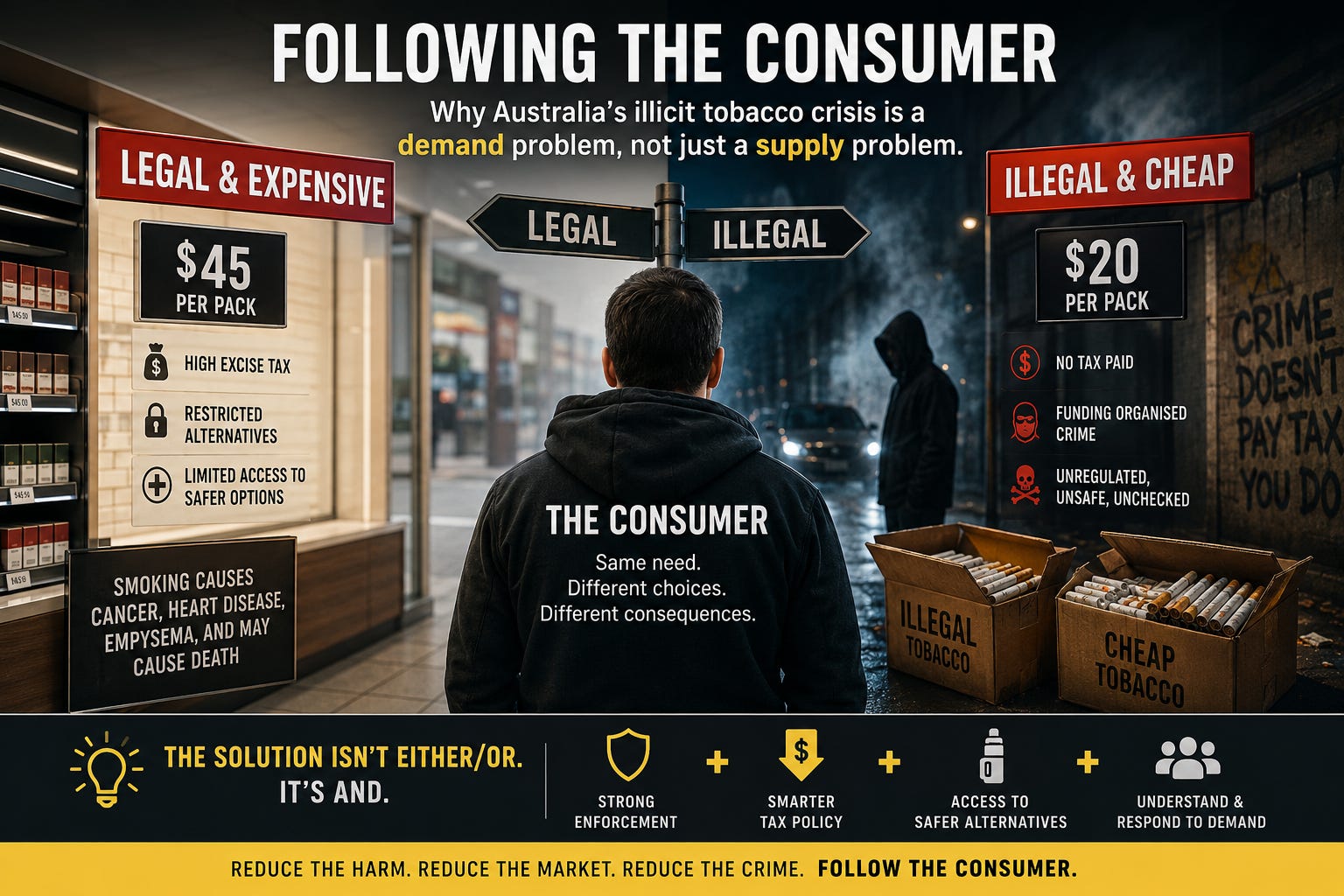
Australia’s illicit tobacco crisis has reached a remarkable point. No one disputes that organised crime has become deeply embedded in the tobacco market. Firebombings, extortion, illegal factories, counterfeit products and billions of dollars in lost excise revenue have transformed what was once primarily a public health issue into a major law enforcement problem. The debate is no longer about whether there is an illicit market. It is about what created it and, more importantly, what will make it shrink.
In a recent ABC Radio National interview, Australia’s Illicit Tobacco and E-cigarette Commissioner, Amber Shuhyta, argued that reducing tobacco excise would not solve the problem. Criminal organisations, she explained, are already well established and, even if taxes were reduced, they would simply continue to undercut legal prices because organised crime has adapted, diversified and become resilient. There is truth in that argument. Once criminal networks establish profitable supply chains, they rarely disappear overnight, and no serious observer believes that reducing tobacco taxes tomorrow would magically dismantle organised crime the following day.
But there is something important missing from this conversation. The discussion focuses almost entirely on the criminals while saying very little about the customers. Markets exist because of supply and demand. Criminals may supply illegal cigarettes, but consumers create the demand, and every packet purchased represents a decision made by an ordinary smoker.
The obvious question therefore becomes: why are so many Australians choosing illegal tobacco?
The answer is uncomfortable because it is largely economic. Legal cigarettes have become extraordinarily expensive and, for many smokers, particularly those on lower incomes, the difference between legal and illegal products amounts to thousands of dollars each year. While health warnings may encourage quitting, financial pressures often encourage something quite different: finding a cheaper source.
Public policy frequently assumes that consumers make decisions based solely on health messages. Reality is far more complicated. People respond to incentives. If two products satisfy the same nicotine dependence but one costs a fraction of the other, many consumers will inevitably choose the cheaper option. This is not an endorsement of illegal tobacco. It is simply how markets work.
The Commissioner’s argument appears to assume that organised crime has now become largely independent of tobacco tax policy. Even if legal cigarettes became cheaper, criminal groups would simply lower their prices further. Perhaps that is true. But it raises a far more important question: what size illicit market are we prepared to accept?
Every country experiences some level of illicit tobacco trade, so the objective should never be to eliminate it entirely because that is probably impossible. The real objective should be to minimise it. There is an enormous difference between a country where illicit tobacco accounts for around five per cent of sales and one where estimates suggest it dominates most of the market. Those are two very different situations requiring two very different policy responses.
Yet the interview presents the issue almost as though there are only two choices: maintain high taxes and enforce the law, or reduce taxes and surrender to organised crime. That is a false choice because there is another question that receives almost no attention.
Why is Australia still trying to solve a nicotine problem almost exclusively through cigarettes?
Smoking remains responsible for almost all tobacco-related disease and death, yet consumers who cannot or will not quit nicotine entirely face remarkably few practical alternatives. Vaping remains available only through a heavily restricted medical pathway. Nicotine pouches remain prohibited. Heated tobacco products are effectively unavailable. Meanwhile, illegal cigarettes remain widely accessible.
This creates one of the greatest paradoxes in Australian public health policy. The most dangerous nicotine product is the easiest to obtain illegally, while lower-risk alternatives are among the hardest to obtain legally. If public health genuinely wants smokers to stop smoking, shouldn’t safer alternatives compete with cigarettes instead of being regulated out of reach?
The discussion on Radio National barely acknowledges this possibility. Instead, the debate centres on whether enforcement should be increased or taxes reduced. Both questions matter, but neither addresses the broader transformation taking place in nicotine markets around the world.
Countries such as Sweden, New Zealand and Japan demonstrate that large reductions in smoking are possible when smokers have access to appealing alternatives. These countries have not eliminated nicotine. They have reduced smoking. Australia, however, continues to judge success almost entirely through the lens of cigarette control while treating alternative nicotine products with suspicion.
This approach ignores one of the simplest principles of economics. Consumers do not disappear because policymakers dislike their choices. If legal markets fail to meet demand, illegal markets will fill the gap. Every successful black market throughout history has relied on the same formula: restrict supply, increase price and leave demand largely unchanged. Organised crime simply steps in to meet that demand.
The Commissioner understandably focuses on dismantling criminal organisations because that is her job. But governments must ask a different question: why is organised crime finding this market so attractive in the first place?
Law enforcement can arrest offenders, seize products, close shops and increase penalties, but none of those measures changes the basic economic incentive that encourages consumers to seek cheaper nicotine products. History repeatedly shows that enforcement alone rarely defeats a highly profitable black market. It increases costs, disrupts supply and raises risks, but as long as demand remains strong and profits remain extraordinary, new suppliers will continue to emerge.
This does not mean enforcement is unnecessary. Far from it. Criminal organisations should be pursued relentlessly, and violence, extortion and illegal manufacturing deserve a strong law enforcement response. But enforcement treats the symptoms. It does not necessarily cure the disease.
The uncomfortable reality is that Australia may now be fighting yesterday’s battle. The conversation remains focused on defending the legal cigarette market against illegal cigarettes instead of asking how smokers themselves can be encouraged to leave cigarettes behind altogether.
That requires thinking differently. It requires recognising that tobacco control is no longer simply about taxation and enforcement. It is about consumer behaviour. It is about incentives. It is about providing smokers with realistic pathways away from combustible tobacco.
Most importantly, it requires accepting that markets respond to policy. When governments make safer alternatives difficult to access while making cigarettes increasingly unaffordable without eliminating demand, they should not be surprised when criminal entrepreneurs identify an opportunity.
The Commissioner is right about one thing. There is no simple fix. But neither is there a simple explanation. Australia’s illicit tobacco crisis is not merely a policing problem. It is also the predictable consequence of a market that policymakers have shaped over many years.
If we continue to focus only on the people supplying illegal tobacco while refusing to examine why so many consumers buy it, we will continue fighting the fire while ignoring the fuel. Until that changes, organised crime will continue to do exactly what markets always reward it for doing: supplying a demand that public policy has failed to understand.
If they removed the excise completely you could sell a pack of 20 for around $10. Chapman's argument goes like this: but even if you did that, criminals could sell them even cheaper. Yes, they could. But there a big difference between paying an extra $3 - 5$ for a legal packet and paying a extra $20 - $40. A significant portion of smokers would return to the legal market as a result. It may not completely eradicate the BM but it would certainly greatly reduce it to manageable levels.
Every time when hear her speak or read her statements, i can see Simon Chapman and Becky Freeman whispering in her ear.
Untill the government and their appointees step away from them and start thinking outside " the box", nothing will change.
But since they are going to ban nicotine pouches as well and in that way add just another product to the black market, nothing will change anytime soon.
Let them, just let them.