

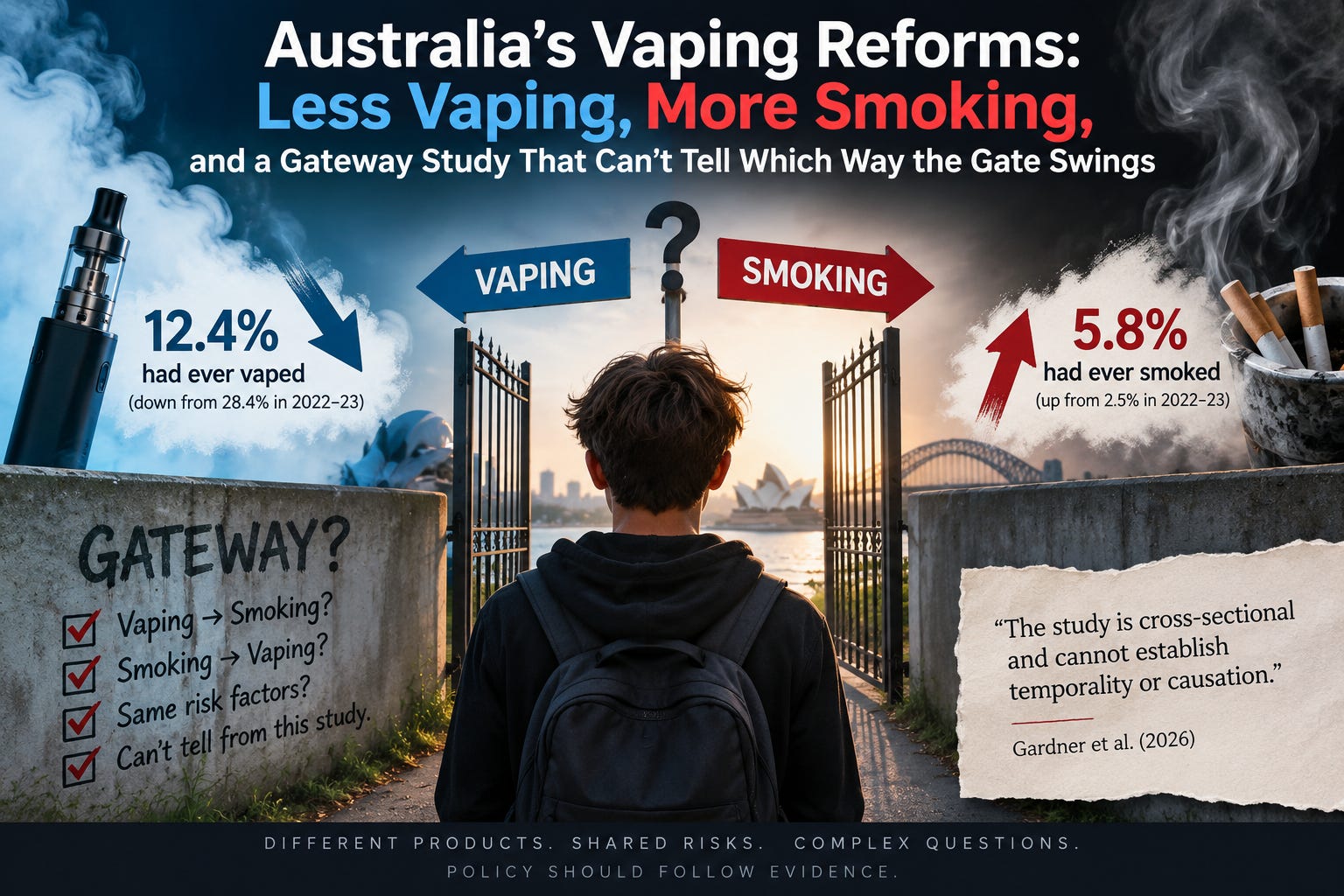
There is something rather revealing buried in this Australian adolescent nicotine study.
After Australia’s sweeping 2024 vaping restrictions, the researchers found lifetime vaping of 12.4% in their sample, compared with 28.4% among 14–17-year-olds in the earlier 2022–23 national survey.
But lifetime cigarette smoking went in the opposite direction: 5.8% compared with 2.5% in the earlier survey.
That should at least make people curious.
It does not prove that Australia’s vaping restrictions caused teenagers to smoke. The study cannot establish that, and neither comparison should be treated as a clean national trend because this sample wasn’t nationally representative.
But that’s precisely the point.
This paper cannot tell us whether the 2024 reforms caused vaping to decline either.
It surveyed 1,848 students from just 20 independent and Catholic schools across three states, predominantly in metropolitan areas. It is cross-sectional, has no genuine pre-reform comparison group and cannot establish causation or even the order in which these products were used.
The authors openly acknowledge these limitations.
There is another important issue. The study measures lifetime use.
A teenager who experimented with a vape once is counted as having used e-cigarettes. Someone who tried a nicotine pouch once is a lifetime pouch user. That tells us something about experimentation, but very little about regular nicotine consumption, dependence or harm.
Again, the authors acknowledge this themselves, saying lifetime use may simply represent experimentation rather than ongoing use.
And look more closely at the supposedly emerging nicotine-pouch problem.
Lifetime pouch use was only 3.5%, and it was overwhelmingly concentrated among teenagers who had already experimented with other nicotine products. Among adolescents who had never vaped, just 0.7% had tried a pouch. Among those who had never smoked, the figure was 1%.
That suggests something quite different from three independent nicotine epidemics sweeping through Australian schools.
It suggests there may be a relatively small group of teenagers inclined to experiment with multiple nicotine products.
Indeed, that’s essentially what the researchers themselves acknowledge when they suggest there may be shared risk factors across products.
So perhaps the most interesting question raised by this paper isn’t whether Australia needs another crackdown on another nicotine product.
It is whether we are correctly identifying the problem in the first place.
And there is an uncomfortable number sitting right in the middle of these results:
Vaping: 12.4% lifetime use.
Smoking: 5.8% lifetime use.
Compared with the earlier national figures cited by the researchers:
Vaping: 28.4%.
Smoking: 2.5%.
Again, these aren’t directly comparable surveys and shouldn’t be presented as proof of substitution.
But if vaping experimentation appears dramatically lower while cigarette experimentation appears substantially higher, surely that deserves investigation before declaring the regulatory experiment a success.
The objective of youth nicotine policy shouldn’t simply be to produce the lowest possible vaping number.
It should be to produce the lowest possible harm.
If fewer teenagers vape but more experiment with combustible cigarettes, that is not automatically a public-health victory.
And before calling for further restrictions based on this study, we should probably establish whether these teenagers are experimenting occasionally, using nicotine regularly, becoming dependent, switching between products or moving towards or away from cigarettes.
This study cannot answer those questions.
Its authors say so themselves.
One other disclosure is worth noting without overstating it: several authors report relationships with the OurFutures Vaping prevention program, including patents licensed to the OurFutures Institute, board membership, consulting/advisory involvement, and, in one case, equity in a related entity. These are disclosed competing interests, not evidence that the results are biased, but given that the paper recommends continued nicotine-prevention strategies, readers are entitled to know about them.
The study also demonstrates why we need to be careful with the so-called “gateway” argument. The researchers found that vaping, smoking and nicotine-pouch experimentation were strongly associated. But they cannot tell us which product came first. A teenager who smoked first and later tried vaping looks exactly the same in these lifetime-use data as a teenager who vaped first and later tried smoking. The authors explicitly acknowledge that their cross-sectional study cannot establish temporality or causation and suggest that shared risk factors may explain the overlap. In other words, correlation between vaping and smoking is not evidence that vaping causes smoking. If someone tried to use this study as evidence for a vaping gateway to smoking, they'd also have to explain why the same logic wouldn't imply a smoking gateway to vaping or smoking/vaping gateways to nicotine pouches. The design simply cannot determine the direction.
Oh dear. Wat a cockwomble of fuckability. Does that exist 🤔?
Well overdue for albo n bumlet to burn their butts n introduce some aussie adult smokers' lives n stop worrying about snot gobblers vaping n a very debatable non existent gateway to stinkies