

A quick apology for the length of this piece, but there is simply a great deal of information to work through if we are going to understand properly what Australia’s 5.8% smoking figure does, and does not, tell us.
Australia’s latest smoking statistic sounds remarkably simple: just 5.8% of Australian adults smoked daily in 2025. It is the sort of number that fits perfectly into a press release, a headline or a political talking point because it suggests that smoking is rapidly disappearing and that decades of tobacco-control policy are delivering precisely the result intended.
But before we start celebrating 5.8% as if it describes the entire Australian smoking market, here is the factual picture in brief.
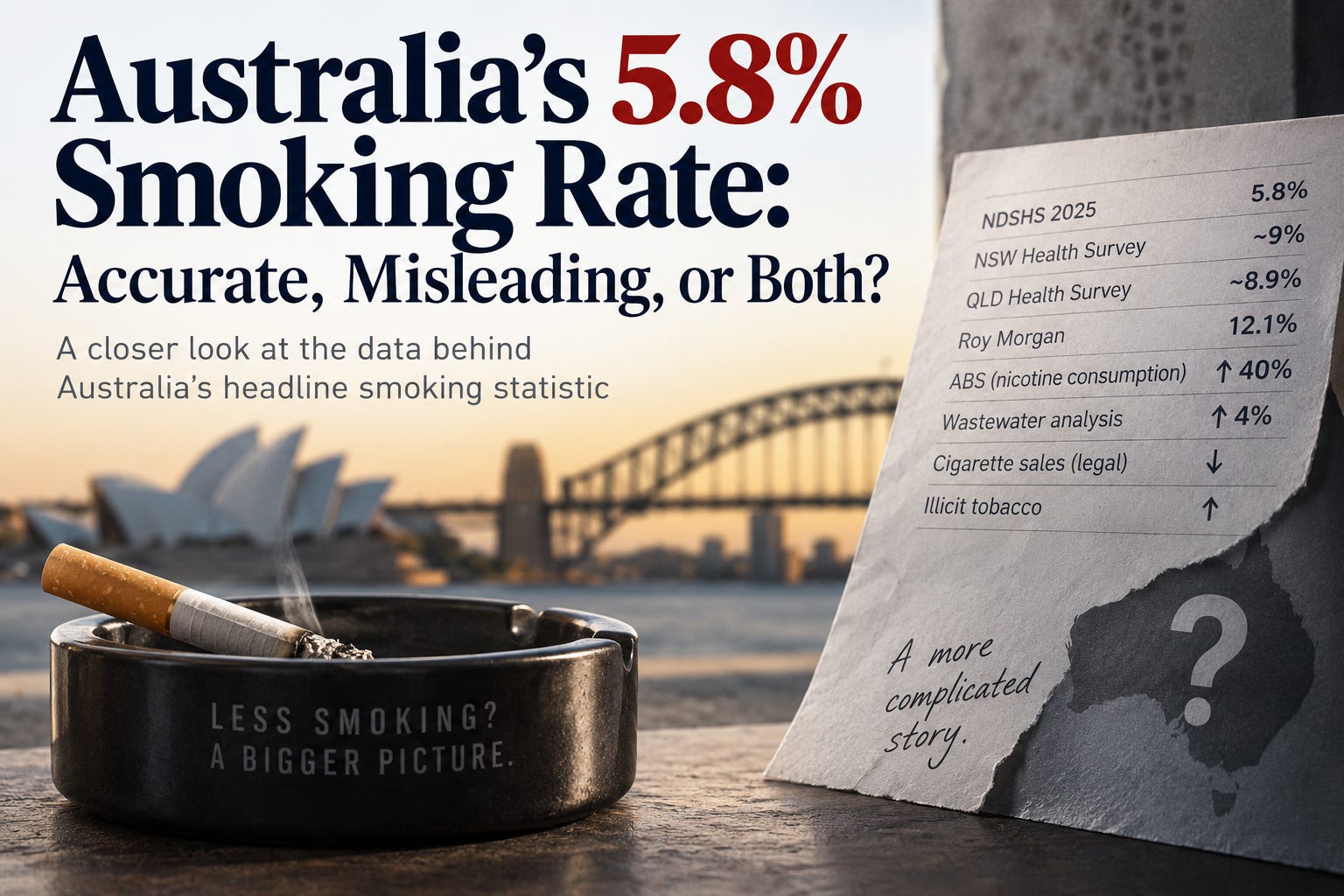
The 5.8% figure measures adults who reported smoking every day, not everyone who smokes. The same NDSHS reports a higher figure when occasional smokers are included. New South Wales reported daily smoking around 9% in 2025 and daily or occasional smoking around 15%. Queensland recently reported daily smoking around 8.9%. Roy Morgan estimated 12.1% of Australian adults smoked manufactured or roll-your-own cigarettes in the year to June 2025. The ABS has estimated that total nicotine consumption increased by almost 40% between 2017 and 2025, while wastewater analysis found national nicotine consumption increased around 4% between August 2024 and August 2025. None of that proves that 5.8% is wrong, but it does make the simple story considerably harder to sustain.
To be absolutely clear, I have not found evidence proving that the 5.8% estimate itself is incorrect, and I am not going to manufacture that argument simply because it would make for a better headline. The figure comes from the 2025 National Drug Strategy Household Survey and refers specifically to adults aged 18 and over who reported smoking tobacco every day. It is a legitimate survey estimate of a clearly defined behaviour, but that is quite different from saying that only 5.8% of Australians smoke, and it is very different again from saying that tobacco use, cigarette consumption or nicotine consumption in Australia has fallen to historically tiny levels. Those distinctions are not statistical pedantry; they are central to understanding what is actually happening.
The same National Drug Strategy Household Survey reports that 7.8% of Australians aged 14 and over were current smokers in 2025 when occasional smoking is included, so even within the same survey a broader definition produces a noticeably higher number. The 5.8% statistic therefore should not casually become “Australia’s smoking rate” without the words “adult” and “daily” attached to it. That may sound like a small qualification, but watch what happens when we start comparing 5.8% with other Australian evidence.
Take New South Wales, where the NSW Population Health Survey reported that around 9% of people aged 16 and over smoked daily in 2025, while around 15% smoked either daily or occasionally. That is not an historical figure dredged up from a decade ago. It is an independent estimate from the same year as the NDSHS, and New South Wales contains roughly a third of Australia’s population. A state containing that many Australians reporting daily smoking at around 9% sits somewhat awkwardly beside a national adult estimate of 5.8%. It does not mathematically disprove the national figure because the surveys use different methods, age cut-offs, sampling systems and weighting, but surely it deserves more than a shrug.
Queensland creates a similar problem. Its health surveillance reported adult daily smoking around 8.9% in 2024, with another 4.3% smoking less frequently than daily. That survey was conducted earlier, and smoking may have only gradually declined, but again the gap is large enough to warrant serious examination rather than simply assuming that every Australian smoking survey would cover the same population in the same way and yield interchangeable results. Western Australia adds another complication because recent WA surveillance has produced daily-smoking estimates above the national NDSHS figure and has even recorded periods in which smoking increased rather than declined.
None of these state surveys independently invalidates the NDSHS, but together they tell us something important: nobody is standing at the Australian border with a clicker counting smokers as they walk past. These are estimates, and survey estimates depend on who is contacted, who participates, how the questions are framed, how respondents interpret them, how the results are weighted, and who is not captured at all. That should make us cautious about pretending the decimal point has greater precision than the underlying measurement allows.
The Australian Bureau of Statistics gives us another reason for caution. Its National Health Survey estimated that 10.6% of Australian adults were daily smokers in 2022, while around the same period the National Drug Strategy Household Survey produced a lower estimate. Two major government surveys examining smoking in Australia were therefore already producing materially different prevalence estimates before 5.8% entered the national conversation. That does not mean either survey was defective. It means smoking prevalence is estimated rather than directly counted, yet once these estimates enter public debate, that uncertainty has a strange tendency to disappear and the number becomes the fact.
Then there is Roy Morgan. Its large national survey estimated that 12.1% of Australian adults smoked factory-made or roll-your-own cigarettes in the year to June 2025, and Roy Morgan surveys approximately 60,000 adults annually, substantially more than participated in the latest NDSHS. Again, these are not perfectly comparable measures. Roy Morgan is measuring cigarette smoking incidence rather than specifically daily smoking, so putting 12.1% beside 5.8% and declaring one right and the other wrong would be intellectually lazy. But ignoring the difference altogether would be equally lazy. Among younger adults, the divergence becomes particularly interesting, with Roy Morgan reporting substantially higher cigarette smoking among 18 to 24-year-olds than the NDSHS reports for current smoking in roughly the same age group. Maybe there are good methodological reasons. If so, explain them. That is a far more useful response than pretending the discrepancy does not exist.
The story becomes even more interesting when we stop asking people whether they smoke and start examining what Australians appear actually to be consuming. In June 2026, the Australian Bureau of Statistics published experimental estimates of household tobacco and nicotine consumption, with its modelling suggesting that the total quantity of nicotine consumed in Australia increased by almost 40% between 2017 and 2025. The increase substantially exceeded population growth, with much of it attributed to vaping and illicit tobacco rather than legal cigarette sales. This does not contradict falling daily smoking prevalence because people can stop smoking cigarettes and begin vaping, a smaller pool of smokers can consume more cigarettes per person, nicotine consumption is not the same thing as smoking prevalence, and the ABS itself appropriately describes these estimates as experimental. But it should stop us from saying things the data do not support. A country in which daily cigarette smoking is declining can simultaneously be a country in which nicotine consumption is increasing, and that distinction matters enormously for tobacco harm reduction because reducing smoking and reducing nicotine use are not the same public-health objective.
The Australian Criminal Intelligence Commission’s wastewater data adds another layer. Wastewater analysis found national nicotine consumption increasing by around 4% between August 2024 and August 2025. Wastewater cannot distinguish precisely between nicotine consumed through cigarettes, vaping, nicotine replacement therapy or other products, but it has one rather useful quality: wastewater does not care what respondents tell a survey interviewer; it measures what ends up in the sewer. So during roughly the same period in which survey data recorded another dramatic decline in smoking prevalence, an objective population-level indicator suggested Australians were consuming more nicotine rather than less. Both findings can be true, and in fact that is probably the most important lesson in this entire debate. Australia’s tobacco and nicotine market has become too complicated to be described honestly by one number.
Legal cigarette sales are perhaps the clearest example. For many years, falling tobacco excise receipts or cigarette shipments could reasonably be interpreted as supporting evidence that smoking was declining, but that relationship becomes much weaker when the illicit market becomes enormous. Australian Border Force detections now involve billions of illicit cigarettes, hundreds of tonnes of loose tobacco and millions of illegal vaping products, while the NDSHS itself reports a sharp increase in illicit-tobacco use among current smokers. A legal cigarette disappearing from an excise spreadsheet can therefore mean at least three very different things: the smoker may have quit, the smoker may have switched to vaping, or the smoker may simply have purchased an illicit cigarette instead. From a public-health perspective, those outcomes could hardly be more different, yet a fall in legal cigarette sales records all three in exactly the same way. Gone. That is why legal sales cannot be treated as a smoking prevalence measure.
There is also the extraordinary speed of the decline recorded by the NDSHS. Among Australians aged 14 and over, daily smoking fell from 11.1% in 2019 to 8.3% in 2022–23 and then to 5.6% in 2025, while among adults the latest estimate is 5.8%. Perhaps that decline is entirely real. There are several plausible reasons why it could be: younger Australians smoke much less than previous generations, many older smokers continue to quit, some smokers have undoubtedly switched completely to vaping, and demographic replacement gradually removes generations with much higher smoking prevalence. But the more extraordinary the change, the stronger the case for independent confirmation. We should want the 5.8% figure tested, not protected. That is not an attack on AIHW; it is how serious evidence should work.
The next ABS National Health Survey will therefore be particularly important. The ABS estimated adult daily smoking at 10.6% in 2022. If its next independent estimate comes in somewhere around 5.8%, that would provide strong corroboration that Australia has experienced an exceptionally rapid decline in adult daily smoking. If it instead produces a materially higher figure, then we will have a fascinating and important methodological question to answer. Either way, we learn something.
There is another issue that deserves attention: survey participation and methodology. The 2022–23 NDSHS included more than 21,000 respondents, while the 2025 survey included more than 17,500. That remains a substantial sample, but household survey participation has become increasingly difficult, response rates have fallen, and data-collection methods have changed over time. The NDSHS also primarily samples people living in private households, meaning some populations are outside its scope. Every national survey has exclusions and limitations, and that does not invalidate the work, but those details matter more when the result being produced is unexpectedly low and is subsequently promoted as a definitive description of Australian smoking.
Which brings me to what I would like AIHW to do next. First, publish the complete 2025 methodological documentation as transparently as possible, including the final response rate, survey-mode breakdown, weighting procedures, sample composition and any methodological changes from 2022–23 that might affect comparability. Second, explicitly explain the difference between the 5.8% adult daily-smoking estimate and broader measures of current smoking so that politicians, journalists and health organisations do not casually convert “adult daily smoking” into “Australians who smoke”. Third, examine the divergence between the NDSHS and other contemporary Australian surveys rather than leaving everyone else to guess. Why does NSW find daily smoking around 9%? Why has Queensland recently reported higher estimates? Why does Roy Morgan find substantially more cigarette smoking? Why did the ABS National Health Survey previously produce a higher adult daily-smoking estimate? There may be perfectly reasonable methodological explanations for all of these differences. Tell us what they are.
Fourth, when the full 2025 data are released, provide sensitivity analyses around the smoking estimates and confidence intervals prominently enough that readers can understand the uncertainty surrounding 5.8%. A prevalence estimate to one decimal place can create an illusion of precision that population surveys simply do not possess. Finally, I would like AIHW to resist the temptation, or pressure from others, to allow one favourable prevalence statistic to become a proxy for the performance of Australia’s entire tobacco strategy.
The Australian nicotine market is undergoing one of the most dramatic transformations in its history. Daily smoking is falling, vaping has expanded, the illicit cigarette market has exploded, legal tobacco sales have collapsed, and total nicotine consumption appears to have increased. Those things can all be happening at the same time. Pretending otherwise does not make tobacco control stronger; it makes our understanding of the market weaker.
We do not need to claim that 5.8% is false. We need to stop pretending that 5.8% tells us everything. It tells us something very specific: in one major national survey, 5.8% of Australian adults reported smoking every day in 2025. That is useful information, but it does not tell us that only 5.8% of Australians smoke, how many Australians smoke occasionally, how much tobacco is being consumed, how much is being purchased illegally, how much nicotine Australians use or how many smokers have switched to safer nicotine products. Those are different questions requiring different evidence, and Australia should be interested in all of them.
If adult daily smoking really has fallen to 5.8%, that deserves recognition. If vaping has contributed significantly to that fall, that deserves recognition too. If smokers are increasingly substituting illicit cigarettes for legal ones, policymakers need to know that rather than congratulating themselves on falling excise-paid sales. And if nicotine consumption is rising while combustible smoking is falling, perhaps it is time to acknowledge that eliminating smoking and eliminating nicotine are not remotely the same thing.
The evidence is telling us a complicated story, and we should not be frightened of it simply because the simple story is easier to put in a press release. The 5.8% figure may ultimately prove to be remarkably accurate, but extraordinary progress deserves extraordinary scrutiny. If the number is as robust as it appears, greater transparency will strengthen it, and if examining the surrounding evidence changes our understanding of what is happening in Australia, that is not a failure of tobacco control. That is the whole point of collecting evidence in the first place.
Absolutely fascinating stack. So many variables. Shame can't get accurate figure for illicit tobacco!!
Thank you mate
Perfectky articulated.